
Exploring the World of DJing
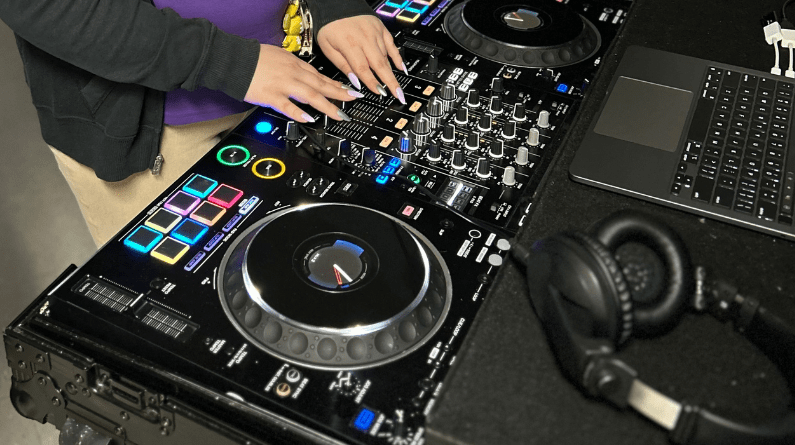
While DJ technically stands for “Disc Jockey,” DJing now generally refers to playing pre-recorded music for an audience. DJs curate and blend songs – or “tracks” – to establish a certain mood or energy and heighten the experience of listening to music.
A variety of techniques can be used to DJ. Some DJs use turntables and play vinyl records, some use DJ controllers or CDJs to play digital music, some even incorporate instruments into their sets. Usually, there are at least two sound sources – or “decks” – which allow DJs to seamlessly transition from one song to the next or blend elements of both to create a unique sonic experience. There are technical skills involved in DJing like beatmatching, mixing, and gainstaging. The most important skills a DJ should develop are a good ear and a deep knowledge of their tracks. DJing is a great way to get students directly involved in school events like dances and pep rallies. It can also be a hands-on way to explore modern music history and technology.
All you need to start DJ-ing is a DJ controller, DJ software (many controllers have this included), headphones, and a laptop. Check out the video below for how to use a DJ controller including initial set-up and first steps.
Best Software for DJing: Recommendations for getting started
DJ Software allows you to comprehensively analyze, organize, and manipulate a digital library of music and communicate with your DJ controller. The most popular DJ Softwares are Rekordbox and Serato. Both Rekordbox and Serato have free versions available. Many DJ controllers also come with licenses to either, so make sure you take advantage of any included software.
*NOTE* – Make sure your DJ controller and software are compatible! Most DJ controllers only work with specific software, so check the box before you download anything
Streaming Service Integration
Most major DJ software now connects directly to streaming platforms, so students don’t need to build a downloaded music library from scratch to get started. Rekordbox and Serato both support TIDAL, Beatport, Beatsource, and SoundCloud, and recently added Spotify integration as well (a Spotify Premium subscription is required). This is a great way for students to explore and mix music they already listen to. Keep in mind that streamed tracks don’t always offer the same level of control as downloaded files. Features like cue points, hot loops, and stems may be limited or unavailable depending on the service, so streaming works best for practice and casual mixing, while downloaded libraries are still preferred for more precise, performance-ready sets.
DJ software is essentially a library of music on the bottom and a digital representation of your controller and decks at the top. If you want to play a song, all you have to do is…
- Drag a track from your library into one of the decks (top left or right) Note: if you’re using a streaming service like Spotify or TIDAL, make sure you’re logged in first so those tracks appear alongside your downloaded library
- Press play on that deck to start the track
- Load your next track into the opposite deck the same way
- Use the headphone cue function to preview and beatmatch the incoming track before the audience hears it
- Use the channel faders and crossfader to gradually bring in the new track while fading out the old one. This is the actual “mixing” step
- Adjust the channel volume and master/PA volume separately as needed. These control different things, and new DJs often only adjust one
And voila – you’re DJ-ing!