
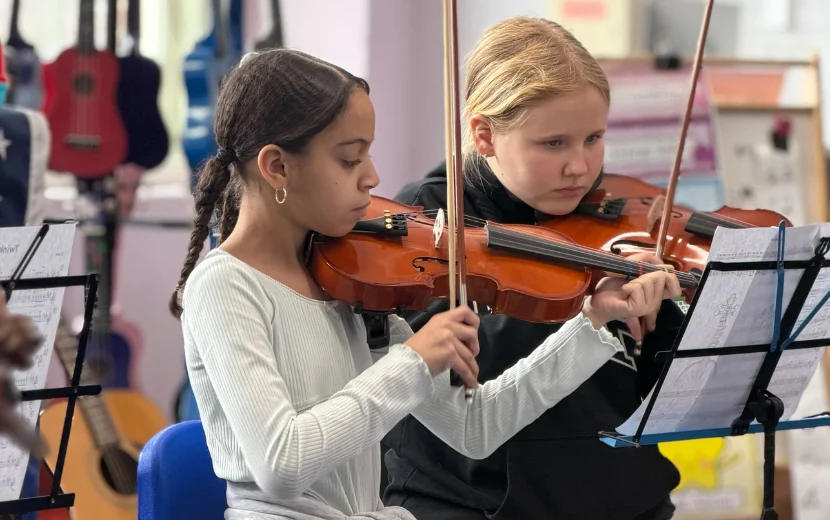
Wondering when your child should begin music lessons? Many music educators point to ages 6–9 as a common window for formal instruction, but readiness matters more than the number of candles on a birthday cake. The best age to start music lessons depends on your child’s developmental stage, their interest and the type of instruction available to them.
Why Age Isn’t the Only Factor in Starting Music Lessons
Starting music lessons is a progression, and two factors matter more than age: developmental readiness and the most appropriate or engaging style of instruction for what your child needs.
Developmental readiness has two sides.
- Physical readiness, which includes fine motor skills (the coordination needed to press piano keys or hold a bow) and the attention span to follow a teacher’s direction for a sustained stretch of time (about 30 minutes).
- Emotional readiness, which means your child shows genuine curiosity about music and some willingness to practice, even imperfectly.
When both sides of readiness are present, lessons tend to have a more meaningful impact.
Music Engagement by Age: What to Expect at Each Stage
What music looks like at 2 years old is nothing like what it looks like at 8, and that’s fine. The sections below walk through each stage so you can find where your child is right now and figure out what kind of engagement actually fits them best.
Ages 0–3: Building an Ear Before the First Lesson
Formal lessons typically do not benefit a 2 year old, , but music still does. In the earliest years, exposure is key.. Singing to your child, dancing together, introducing simple musical toys and responding to the rhythms they naturally gravitate toward all help develop auditory pattern recognition and lay the groundwork for future learning.
Ages 3-5: When Group Music Classes Make Sense
Ages 3 to 5 is a good window for group music classes; the kind built around singing, moving, and playing with rhythm. That format works here because it’s social and low-pressure, and it doesn’t demand the kind of sustained focus that one-on-one lessons do. A 2018 study published in Scientific Reports found that kindergartners who attended weekly music playschool showed stronger phoneme processing and vocabulary gains than peers in a comparable dance class or no activity at all, which is a good case for starting with group music rather than jumping straight to private lessons.
Around 4 or 5, some kids will start showing real interest in a specific instrument. If your child keeps gravitating toward the xylophone or banging on anything that makes noise, let them. Hands-on exploration at this age builds a feel for music that structured lessons build on later.
Ages 6–9: The Most Common Starting Point for Formal Lessons
For many children, ages 6 through 9 are when formal music lessons become a good fit. Fine motor skills are more developed, higher literacy opens up access to reading sheet music, attention spans have grown and children at this stage can follow multi-step instruction. If you’re asking what is the best age to start music lessons, this window is where most music educators land because the cognitive and physical pieces tend to align here. It’s also often the age when students learn more about instruments and instrument families through school as well.
Piano, guitar, violin and voice are all common instruments to start with in the formal lesson experience. . And if your child has been asking about something specific (“I want to play drums,” “can I learn guitar like that person”), take that seriously. That kind of pull is a good sign.
Ages 10 and Up: It’s Never Too Late to Start
Older beginners often progress faster than parents expect. A 10- or 12-year-old brings stronger focus and more developed abstract thinking, which accelerates learning. Drums and voice suit older beginners particularly well.
Start at any age, and there’s a benefit!
Signs Your Child Is Ready for Music Lessons
These readiness indicators can help you determine what age to start music lessons. Here’s what to look for:
- Sustained interest in music: They ask to hear certain songs again, move to rhythms spontaneously or try to recreate sounds they’ve heard.
- Ability to follow simple directions: They can complete a two- or three-step instruction without losing the thread.
- Some capacity to focus: Sitting and attending to an activity for 15-20 minutes is a reasonable benchmark for beginning lessons.
- Curiosity about instruments. They ask what something is, want to touch it or ask if they can learn to play it.
Your child doesn’t need all of these before starting. Think of them as things to watch for rather than a bar to clear.
How to Choose the Right Type of Music Instruction
The format of instruction that works the best for a child depends on what is relevant for their interests, their energy and style of play, and what they are ready for.
Group classes work well for younger children (roughly ages 3–7). They’re social, lower-stakes and designed for shorter engagement windows. Kindermusik and Musikgarten-style programs are examples of what this looks like in practice.
Private lessons are a strong fit for school-age children who’ve shown specific instrument interest and can sustain focused attention with a single teacher.
School music programs complement both. For many children, their first instrument experience happens in a school band, orchestra, or chorus program, and access to quality school music programs can make the difference between a child who discovers a lifelong passion and one who never gets the opportunity. That access to music education for all students is exactly what Save The Music works to protect.
Teacher fit matters too. A patient, encouraging teacher can make lessons work at almost any age. If a first experience doesn’t go well, it’s worth trying a different teacher before assuming your child isn’t ready.
For many families, cost and access are the real obstacles. Not every household can afford private lessons or an instrument, which is a big part of why school music programs matter so much.
The Best Age to Start Music Lessons Is the Age Your Child Is Now
Early exposure builds a foundation. Formal lessons tend to click around ages 6–9, although older beginners have advantages too. There’s no single right age, and no version of this where your child is behind.
If you see interest, follow it. If you’re not sure where to start, our music education resources can help you find programs and support in your community. And, if music education in your child’s school is underfunded or absent, advocating for it matters for your child and for every student in that building.
Frequently Asked Questions About Starting Music Lessons
How do you know if your child is musically gifted?
Signs your child is musically gifted might include: strong pitch memory, picking up melodies accurately after hearing them once or twice, a high level of engagement with music and a natural feel for rhythm. That said, giftedness matters a lot less than sustained interest. A child who loves music and wants to keep playing will go further than one who tested well at 4 and lost interest by 7. Any child with genuine curiosity can benefit from lessons.
Are some instruments harder to learn than others?
Some instruments require more physical and technical development before they’re a good fit for young beginners. French horn and oboe have a higher readiness bar since they demand precise embouchure control and breath support that younger children are still developing. Piano and percussion tend to be more accessible across a wider age range.
What instrument should my child start with?
The right starting instrument is one your child is genuinely curious about, sized appropriately for their hands and body, and accessible to them through school or community programs. Piano and percussion are strong foundational choices for younger beginners. Both build rhythm, coordination and music reading skills that transfer to other instruments as a child grows. For many students, their first instrument comes through a school music program, which is one reason equitable access to those programs matters so much. Save The Music Foundation’s instrument grant work exists specifically to close that gap.
How Save The Music Helps Students Start and Stay With Music Education
We work to make sure that instrument access and quality instruction aren’t privileges reserved for students in well-funded schools. Save The Music Foundation restores music education programs in public schools across the country. We provide instruments and support teachers to champion equitable access to music education.
If you want to support that work, you can donate to Save The Music.